| 1. | Whether a retiring Government servant is entitled for leave encashment after retirement under the NPS? |
| The benefit of encashment of leave salary is not a part of the retirement benefits admissible under Central Civil Services (Pension) Rules, 1972. It is payable in terms of CCS (Leave) Rules which will continue to be applicable to the government servants who join the government service on after 1-1-2004. Therefore, the benefit of encashment of leave salary payable to the governments/to their families on account of retirement/death will be admissible. | |
| 2. | Why is it mandatory to use 40% of pension wealth to purchase the annuity at the time of the exit (i.e. after the age of 60 years) from NPS? |
| This provision has been made in�the New Pension Scheme with an intention that the retired government servants should get regular monthly income during their retired life. | |
| 3. | Whether any minimum age or minimum service is required to quit from Tier-I? |
| Exit from Tier-I can only take place when an individual leaves Government service. | |
| 4. | Whether Dearness Pay is counted as basic pay for recovery of 10% for Tier-I? |
| As per the New Pension Scheme, the total Dearness Allowance is to be taken into account for working out the contributions to Tier-I. Subsequently, a part of the �Dearness Allowance� has been treated as Dearness Pay. Therefore, this should also be reckoned for the purpose of contributions. | |
| 5. | Whether contribution towards Tier-I from arrears of DA is to be deducted? |
| Yes. Since the contribution is to be worked out at 10% of (Pay+ DP+DA), it needs to be revised whenever there is any change in these elements | |
| 6. | Who will calculate the interest PAO or CPAO? |
| The PAO should calculate the interest. | |
| 7. | What happens if an employee gets transferred during the month? Which office will make deduction of Contribution? |
| As in the case of other recoveries, the recovery of contributions towards New Pension Scheme for the full month (both individual and government) will be made by the office who will draw salary for the maximum period. | |
| 8. | Whether NPA payable to medical officers will count towards �Pay� for the purpose of working out contributions to NPS? |
| Yes. Ministry of Health & Family Welfare has clarified vide their O.M. no. A45012/11/97-CHS.V dated 7-4-98 that the Non-Practising Allowance shall count as �pay� for all service benefits. Therefore, this will be taken into account for working out the contribution towards the New Pension Scheme. | |
| 9. | Whether a government servant who was already in service prior to 1.1.2004, if appointed in a different post under the Government of India, will be governed by the CCS (Pension) Rules or NPS? |
| In cases where Government servants apply for posts in the same or other departments and on selection they are asked to render technical resignation, the past services are counted towards pension under CCS (Pension) Rules, 1972. Since the Government servant had originally joined government service prior to 1-1-2004, he should be covered under the CCS (Pension) Rules, 1972. | |

Monday, September 8, 2014
புதிய பென்ஷன் திட்டம் - சில விளக்கங்கள்

DA RAISED TO 107 % wef 01.07.2014 @@@The Union Cabinet chaired by the Prime Minister, Shri Narendra Modi, today gave its approval for the release of an additional installment of Dearness Allowance (DA) to Central Government employees and Dearness Relief (DR) to pensioners with effect from 01.07.2014. This is an increase of seven percent over the existing rate of 100 percent of the Basic Pay/Pension, to compensate for price rise.
Wednesday, May 21, 2014
Expected Dearness Allowance from July 2014 for Central Govt Employees and Pensioners...
Expected DA- Status, as of March 2014
Expected Dearness Allowance from July 2014 : This time
there is a considerable slackening in the pace of the expected DA. It
looks as if there are plenty of reasons for it.
As of March, the AICPIN has increased by one point and is at 239. The
rapid increase in Consumer Price Index (IW) has been brought under
control now. Election is believed to be one of the reasons for it. Since
price rise and inflation are under control, there is not much of an
increase in All India Consumer Price Index for Industrial Workers. With a
fall in the prices of essential commodities, the AICPIN points have
actually reduced.
Another reason is the reduction of AICPIN by 4 points in December 2013.
The Consumer Price Index, which was steadily rising till then, slumped
by 4 points. It wasn’t much of a shock then because the Additional DA
for the month of January 2014 increased by 10% and had touched 100%.
The All India Consumer Price Index for Industrial Workers Base Year 2001=100, which was at 243, fell by 4 points to end up at 239. It again fell by 2 points to touch 237, thus dampening the expectations surrounding the next additional Dearness Allowance announcements. It looks highly unlikely that the AICPIN would rise by 4 points to return to its previous levels.
To calculate the additional DA for July 2014 based on your expected or desired AICPIN points, click the link given below:
We are of the opinion that there will not be much of a change in what we had said last time(Expected da from Jul 14 - Feb).
The table given below will easily explain you why…
| Month/ Year |
AICPIN (IW) Base Year 2001=100 |
Increased/ Decreased Points in AICPIN |
Total Points Increased | Total of 12 Months | 12 Months Average | % Increase over 115.763 | Approximate DA | Total DA % | DA% Increase Month wise |
| Jan-13 | 221 | 2 | 2535 | 211.25 | 95.49 | 82.49 | 82 | 2 | |
| Feb-13 | 223 | 2 | 2559 | 213.25 | 97.49 | 84.22 | 84 | 4 | |
| Mar-13 | 224 | 1 | 2582 | 215.17 | 99.41 | 85.87 | 85 | 5 | |
| Apr-13 | 226 | 2 | 2603 | 216.92 | 101.16 | 87.38 | 87 | 7 | |
| May-13 | 228 | 2 | 2625 | 218.75 | 102.99 | 88.97 | 88 | 8 | |
| Jun-13 | 231 | 3 | 12 | 2648 | 220.67 | 104.91 | 90.62 | 90 | 10 |
| Jul-13 | 235 | 4 | 2671 | 222.58 | 106.82 | 92.28 | 92 | 2 | |
| Aug-13 | 237 | 2 | 2694 | 224.5 | 108.74 | 93.93 | 93 | 3 | |
| Sep-13 | 238 | 1 | 2717 | 226.42 | 110.66 | 95.59 | 95 | 5 | |
| Oct-13 | 241 | 3 | 2741 | 228.42 | 112.66 | 97.32 | 97 | 7 | |
| Nov-13 | 243 | 2 | 2766 | 230.5 | 114.74 | 99.12 | 99 | 9 | |
| Dec-13 | 239 | -4 | 8 | 2786 | 232.17 | 116.41 | 100.56 | 100 | 10 |
| Jan-14 | 237 | -2 | 2802 | 233.5 | 117.74 | 101.71 | 101 | 1 | |
| Feb-14 | 238 | 1 | 2817 | 234.75 | 118.99 | 102.79 | 102 | 2 | |
| Mar-14 | 239 | 1 | 0 | 2832 | 236 | 120.24 | 103.86 | 103 | 3 |
| Apr-14 | |||||||||
| May-14 | |||||||||
| Jun-14 |
‘Expected DA from July 2014’ completed its third step..!
-----------------------------------------------------------------------------------------------------------------
courtesy:90paisa.blogspot.in
Tuesday, November 5, 2013
Friday, October 4, 2013
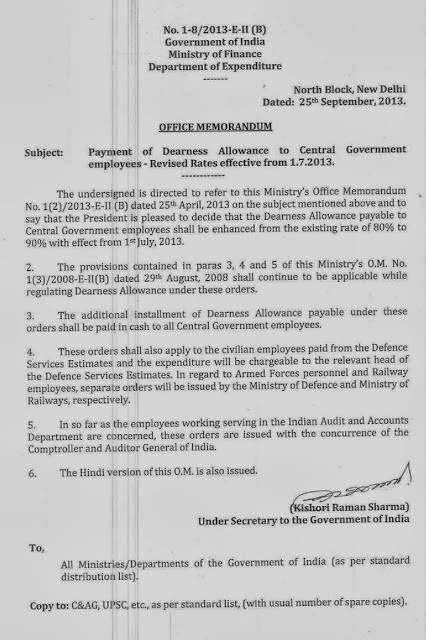
Wednesday, September 25, 2013
7th pay panel award likely to be implemented from January 2016
The government on Wednesday announced the constitution of the Seventh
Pay Commission to revise salary and pension for about 80 lakh staff and
pensioners.
“Prime Minister Manmohan Singh approved the constitution of the 7th Pay
Commission. Its recommendations are likely to be implemented with effect
from January 1, 2016,” Finance Minister P. Chidambaram said in a
statement.
The Congress and the employees union hailed the decision of the UPA-II government.
The union, however, demanded that the pay panel’s award be implemented with retrospective effect from January 1, 2011.
Commerce and Industry Minister Anand Sharma said: “It is the right of
the employees to have the pay commission ...when the recommendations
come, the government will be able to implement [them]. You do not do
something for which you do not have money available.”
The setting up of the commission, whose recommendations will benefit
about 50 lakh Central government employees, including those in Defence
and Railways, and about 30 lakh pensioners, comes ahead of the Assembly
elections in 5 States, including Delhi, Rajasthan and Madhya Pradesh, in
November and the general elections next year.
The government constitutes the pay commission almost once in every 10
years to revise the pay scales of its employees and often these are
adopted by the States after some modification.
The sixth Pay Commission was implemented from January 1, 2006, the fifth
one from January 1, 1996, and the fourth from January 1, 1986.
“Except for 6th Pay Commission, all Pay Commissions are set up in third
year of a decade... The government should attract the best of talent as
its employees.”
Pay Commissions help in attracting and also retaining best available
talent,” Congress general secretary in charge of Communication Ajay
Maken commented on the microblogging site Twitter. “The NDA rejected the
legitimate formation of the 6th Pay Commission in 2003. The Congress
set up the 6th Pay Commission in 2005, now again the 7th CPC in 2013.”
Welcoming the announcement, president of the Confederation of Central
Government Employees and Workers K.K.N. Kutty said: “We have a
reservation. It should be implemented with effect from January 1, 2011
as in the case of Central PSUs whose employee pay scales are revised
every five years.”
During discussions with the government, Mr. Kutty said the Confederation
would press for merger of up to 50 per cent of dearness allowance with
the basic pay, which was a prerequisite for setting up a pay commission.
Subscribe to:
Posts (Atom)
